Nestable roll cage Lift Linear & Tugger Train Compatible
Internal Transport Bottlenecks Start Long Before the Truck Doors Close
When people talk about distribution delays, the conversation usually jumps straight to outbound dispatch. Late trucks. Missed slots. Dock congestion. But if you spend any real time inside a busy DC, you notice something else slowing things down much earlier.
It shows up as blocked aisles, awkward detours around equipment, and workers constantly shifting things out of the way just to keep moving. A lot of this comes down to internal transport — especially what happens after roll cage trolleys are unloaded.
Many teams look for fixes by searching things like “internal transport congestion” or “empty roll cage trolley storage problems.” The answers aren’t always obvious, because the issue isn’t dramatic. It builds quietly.
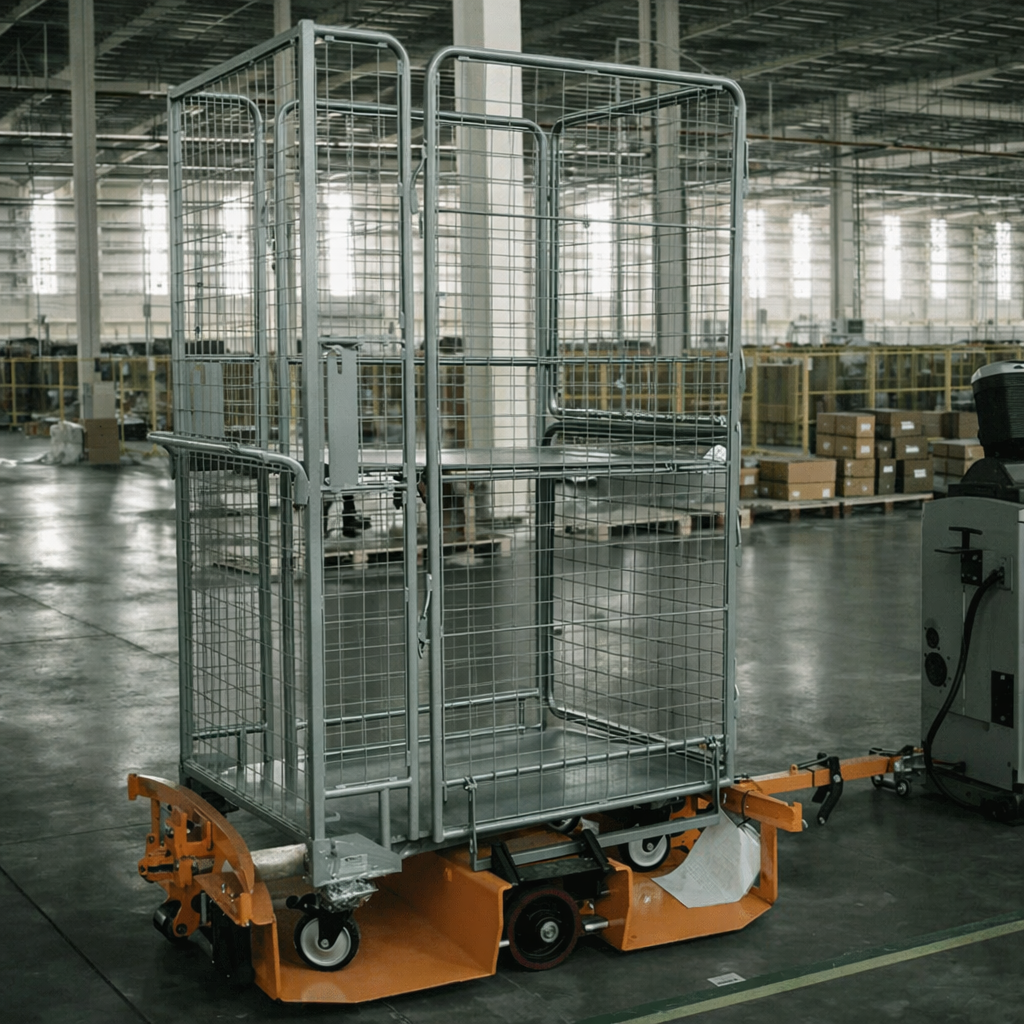
The Real Problem Isn’t Loaded Cages
Roll cage trolleys do their job well when they’re full. No argument there. They protect goods, move easily enough, and fit into existing workflows. The trouble starts once they’re empty.
An empty roll cage trolley still takes up the same amount of space. It still needs to be pushed somewhere. It still ends up parked “just for now” near a workstation or dock. Multiply that by dozens, sometimes hundreds, and suddenly internal movement feels heavier than it should.
This is where things begin to slow down, even though nothing looks broken.
Why Empty Roll Cage Trolleys Create More Congestion Than You Expect
There’s a common assumption that congestion only comes from high volume days. In practice, empty roll cage trolleys cause just as much disruption — sometimes more.
Traditional roll cage trolleys are rigid by design. Once unloaded:
They don’t collapse or reduce in size
They occupy aisles, staging zones, and buffer areas
They rely on someone manually moving them out of the way
So they stack up near liftliners, tugger routes, and packing stations. Not because anyone planned it that way, but because there’s nowhere better to put them.
At that point, flow becomes reactive instead of planned.
How This Quietly Increases Manual Handling and Risk
When roll cage trolley return flows aren’t designed properly, people compensate. They always do.
Extra pushing between zones becomes normal. Temporary parking spots appear where they shouldn’t. Tugger paths get narrower. None of this feels like a big issue in isolation, but over time it adds friction to every shift.
More movement means more fatigue. More clutter means more risk. And while speed usually gets the attention, safety and strain are the things that linger.
Why Rigid Roll Cage Trolleys Struggle With High-Frequency Movement
High-frequency internal transport — especially between workstations, liftliners, and tugger trains — needs flexibility more than strength. This is where traditional roll cage trolleys fall short.
They don’t nest after unloading.
They don’t work well with mechanized return systems.
They waste space during reverse logistics.
You can push through these limits for a while by adding labor or floor space, but that’s rarely sustainable. Eventually, the inefficiencies catch up.
What Changes With Nestable Roll Cage Trolleys
A nestable roll cage trolley doesn’t just improve transport. It fixes the imbalance between forward and return flow.
When loaded, nothing changes — and that’s a good thing. The roll cage trolley still integrates with liftliners and tugger trains, and goods move safely through internal routes.
The real difference shows up when it’s empty.
The roll cage trolley collapses. It nests into others. Suddenly, multiple empty units take up the space of one. Return transport becomes cleaner, storage stops feeling chaotic, and internal paths stay clearer for longer.
This matters more than flashy features. Space efficiency after unloading is where most operations actually win time back.
Designing for the Part Everyone Forgets
Most internal transport problems don’t come from moving goods forward. They come from ignoring what happens after a roll cage trolley is unloaded.
When empty roll cage trolleys are treated as an afterthought, congestion becomes inevitable. When they’re designed into the system — especially with nestable roll cage trolleys — a major source of delay disappears without adding people or square footage.
Sometimes the smartest improvement isn’t about moving faster. It’s about handling empty roll cage trolleys better, and letting the operation breathe again.
Related Blogs
Warehouse Space Is Running Out — And It’s Slowing Everything Down

Innovation in Distribution Storage & E-Commerce products with 10+ years of experience and 40+ Products!
JRD RETAIL SOLUTIONS LLP
21,JATIN INDUSTRIAL ESTATE, 3RD CARTER ROAD, BORIVALI (EAST) MUMBAI-400066, MAHARASHTRA, INDIA.
CONTACT US AT :- +91 7400161116 \ +91 9004476125
EMAIL US AT :- sales@jrdretailsolutions.com
Copyright © 2026 jrdretailsolutions
Powered by Jrd Retail Solutions